


Level 3 - CE1 (Cours Élémentaire 1 / 2nd Grade)
This CE1 French program is part of our online French classes for kids. It helps French-speaking children learn to read longer texts with comprehension, master grammar and conjugation, and write structured sentences.
Our online French lessons for kids focus on enhancing vocabulary through word families, deepening understanding of conjugation (present and future tenses), and developing strong writing skills through 20 structured sessions.
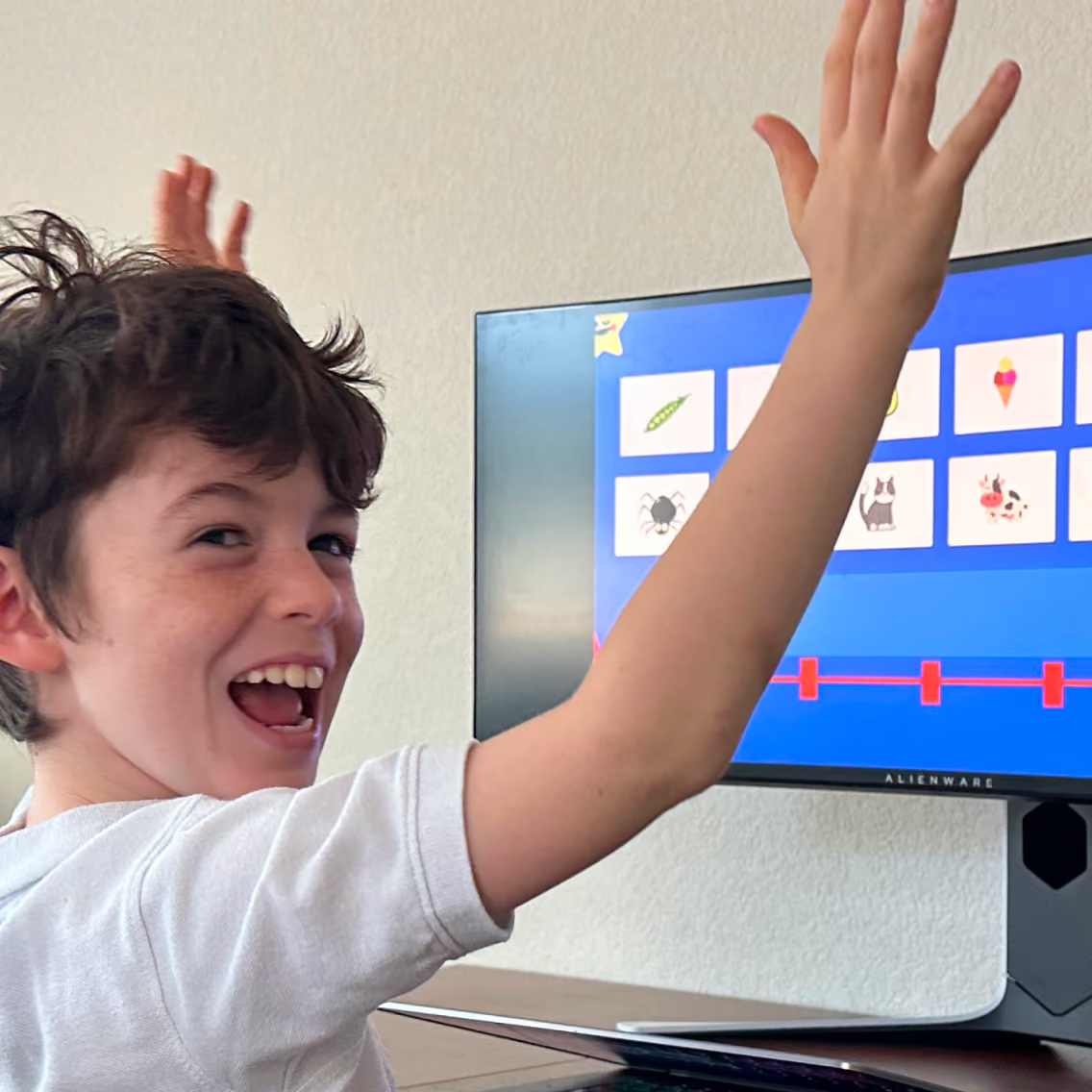
Welcome to CE1
- Reading comprehension of longer French texts
- Grammar mastery (nouns, adjectives, sentence structure)
- Complete present tense conjugation (all 3 verb groups)
- Future tense introduction (futur proche)
- Vocabulary expansion through word families and themes
- Structured sentence and paragraph writing
- Spelling rules and accents (É, È, Ê)
- 25 or 50-minute French classes for kids online
Trusted by 500+ families | Perfect 5/5 rating

What your child willlearn
Our students strengthen their language skills by exploring more complex grammar and discussing various topics. They master verb tenses with greater precision — present, present perfect, past continuous, future — and use the subjunctive to express nuances of feeling or doubt.

Objectives



Skills











What Parents Say AboutOur CE1 Program




Is right for your child?


Your child’s journey through Level 3 CE1
Grammar Foundations & Present Tense
• Words and sentences (les mots et la phrase)
• Sentences and text structure (les phrases et le texte)
• Punctuation (period, question mark, exclamation mark)
• Possessive determiners (mon, ma, mes, ton, ta, tes)
• Affirmative and negative sentences
• Negative sentences (ne...pas, ne...plus, ne...jamais)
• The verb (le verbe) - identification and role
• Verb infinitive (l'infinitif)
• 3 verb groups (-ER, -IR, -RE/OIR)
• Past, present, and future distinction
• "C'est / Ce sont" structures
• Personal pronouns (je, tu, il, elle, nous, vous, ils, elles)
• French alphabet review (vowels and consonants)
• Silent final letters (s, x, p, c, e, t, d)
• Sound [o]: O, AU, EAU
• Sound [k]: C, K, QU, Q, CH
• Sound [j]: G, J
• Classroom verbs (écrire, lire, écouter, parler)
• Days of the week and dates
• Transition adverbs (d'abord, puis, ensuite, enfin)
• Months and seasons
• Family members
• Word families (champ lexical)
• Frequency adverbs (toujours, souvent, parfois, jamais)
• Animal expressions and emblematic animals
• Food, sports, and musical instruments
Write acrostic poems with your name, write dates, create family trees with descriptions, write about magic objects, write sentences using negation, write about preferences
Your child masters sentence structure, punctuation, and begins conjugating verbs in present tense!
Present Tense & Interrogative Forms
• Exclamatory and interrogative sentences
• Common nouns and proper nouns (with capitalization)
• Determiners (articles: le, la, les, un, une, des)
• Interrogative words (qui, que, quoi, où, quand, comment, pourquoi)
• Verb "avoir" (to have) - present tense: j'ai, tu as, il/elle a, nous avons, vous avez, ils/elles ont
• Verb "être" (to be) - present tense: je suis, tu es, il/elle est, nous sommes, vous êtes, ils/elles sont
• Verbs "aller" and "venir" - present tense conjugation
• All uses of avoir and être
• Sound [eu]: EU, ŒU
• Sound [s]: S, SS, Ç, C, SC
• Sound [z]: S, Z
• Body parts and organs
• Emotions (content, triste, fâché, surpris, excité)
• City locations and places
Write doctor dialogues using "avoir mal", write sentences describing emotions (Quand je..., je suis...), write investigation reports with questions and answers
Your child conjugates avoir, être, aller, venir perfectly and asks questions using all interrogative words!
Three Verb Groups & Adjective Agreement
• Masculine and feminine nouns
• Singular and plural nouns
• Noun phrase: determiner + noun
• Noun phrase: determiner + noun + adjective
• Qualifying adjectives: masculine/feminine, singular/plural
• Irregular adjectives
• Adjective agreement in noun phrases
• Present tense: 1st group verbs (-ER) - all conjugations (marcher, parler, manger, jouer, regarder, écouter)
• Present tense: 2nd group verbs (-IR) - all conjugations (finir, choisir, réussir, grandir)
• Present tense: 3rd group verbs (-RE, -IR, -OIR) - irregular verbs (prendre, faire, dire, vouloir, pouvoir, venir)
• Verbs "faire" and "dire" - complete conjugation
• State verbs (verbes d'état)
• Verbs "vouloir" and "pouvoir" - complete conjugation
• Verb "venir" - present tense review
• Accents on E: É, È, Ê
• Sound [é]: É, ER, EZ, ET
• Sound [è]: È, Ê, AI, ET, EI
• Feminine words ending in ELLE, ETTE, ESSE
• Words starting with 2 consonants: DR, TR, CR, GR, VR, FR
• Antonyms and prefixes (in-, im-, dé-, dés-, mal-)
• Giving directions (verbs: tourner, marcher, continuer, s'arrêter)
• Synonyms
• House rooms and objects
• Homophones
• Weather vocabulary
• Physical description
• Image description (landscapes)
• Prefixes and suffixes
Describe a route/path, create riddles about house objects, write sentences using "C'est", write character descriptions, complete image description forms, write postcards
Your child conjugates all 3 verb groups correctly and masters adjective agreement!
Future Tense, Conditional & Writing
• Subject and verb identification
• Subject group and verbal group
• Complete subject group analysis
• Sentence structure mastery
• Futur proche (near future) with "aller" + infinitive: je vais manger, tu vas jouer, il/elle va partir
• Conditional with "vouloir" and "aimer": je voudrais, j'aimerais
• Reflexive verbs (verbes pronominaux): se réveiller, se laver, s'habiller, se coucher
• Sound [in]: IN, AIN, EIN
• Sound [oin]: OIN
• Sound [an]: AN, EN
• Sound [on]: ON, OM
• Sound [j]: ILL, IL, Y, I
• Telling time (review and expansion)
• Professions and careers
• Daily tasks and routines
• Transition adverbs review
Write invitations, create charades (word puzzles), write daily routine descriptions for a specific day
Final comprehensive CE1 assessment - Grammar, conjugation, reading, writing
Your child has completed the CE1 French program and masters grammar, present tense, and future tense! Ready for CE2 (3rd grade)!

FAQsabout onlineFrench classes for kids
Our online French summer camp is designed for children ages 5 to 15. Our native teachers adapt every lesson to your child’s age, level, and learning style whether they’re a total beginner or already have some French. Every child gets a program that feels just right for them.

Not at all. All levels are welcome, including complete beginners who have never heard a word of French. Our native teachers use games, visuals, and storytelling to make everything clear and fun from the very first lesson, no prior knowledge needed, just a smile and a screen.
Your child gets a free 25-minute 1-on-1 lesson with a native French teacher. No credit card required, no automatic billing, and absolutely no commitment. You simply decide afterward whether you’d like to continue most families book their first week the same day.
The camp is completely flexible, join for as little as 1 week or up to 10 weeks, with up to 5 sessions per week. You choose the duration that fits your summer. There’s no need to commit to all 10 weeks upfront — you can add weeks as you go.
Yes, and that’s one of the things that makes our program special. Your child works with the same dedicated native teacher all summer long. This consistency builds trust, confidence, and real momentum. Their teacher will know their name, their pace, and what makes them tick.
Just a computer or tablet with a camera and a stable internet connection. We use Zoom, you’ll receive a link before every session. No special software, no materials to buy, and no complicated setup. If your child can join a video call, they’re ready to go.
Apps and group classes give every child the same experience. We don’t. Every lesson at Little French Speakers is 100% personalized, built around your child’s level, pace, interests, and goals. They work 1-on-1 with a real native teacher who adapts in real time. No algorithm, no waiting, no getting lost in a group. Just your child and a teacher who’s fully focused on them.
After the free trial, you will receive an email with your child’s level placement and the recommended class duration based on their attention span.
Yes, to ensure continuity, each class across all levels is delivered by the same teacher.
Yes, it is absolutely possible to organize classes for siblings or friends, as long as the children are of a similar age and have a comparable level of French.

Join our amazing French class!
- Personalized 1-on-1 lessons
- 25 minute or 50 minute classes
- All teachers are native French speakers
- 100% online interactive program